Wednesday, May 30, 2012

HANSEL AND GRETEL SYNDROME


I think if Hansel and Gretel had been wearing the kind of shoes my men wear, their dad would have been able to track them down very easily, even through leaves and grass.
I swear that my guys don’t take a step anywhere in the house but what a big glob of mud or manure, falls off their boots. I sweep, dust mop, vacuum, mop, pull my hair out and want to scream, but know that won’t help. And I don’t think they even realize the mess they leave behind with each step. Every step on the stairs coming up from the basement has a “glob.” Every step coming from the back porch into the kitchen has a “glob.” Plus every place else.
            Their shoes have the waffle type sole on them. And they all have them. If they would only take their shoes off on the back porch, or when they come in the basement door. But these are lace up boots, and it takes time to take them off and put them back on. Especially if all you are doing is going into the kitchen to get your little red book to check on the number of a cow or a calf, a 2 minute job at the most – compared to probably 5 minutes for taking shoes off and putting them back on. I realize there are shoes without that “waffle” type sole, but these are the ones my guys like. It is almost impossible to convince a man to try something different, especially if he is comfortable with what he has!
            And of course we have had a muddy late winter early spring time here, which doesn’t help the situation. A pull-on shoe would help, but have you ever tried to walk through the muck and mud out in the corral with a pull-on shoe, and lose the shoe in the muck? So that’s not a solution. We could have all the books out on the back porch where the guys come in, but we really don’t have that room set up for book work. I guess they could lean against the washing machine or dryer to do their checking in their books, but I’m not sure they would agree to that.
            An office out in the garage, where they would have a desk, a telephone, and even a bathroom connected is another idea. That would save a lot of scooping of muck in the house. But I would probably be expected to visit the garage/office quite often to clean it  and I already have a house bigger than I can or want to keep clean.
Maybe I need to invent a shoe that the guys could wear that wouldn’t leave so many clues as to where they have walked, perhaps one with a detachable sole that was easy to take off and put back on.
            When it comes right down to it, I do enjoy my men dropping in often and I do have rugs everywhere. They don’t always walk on the rugs, but I certainly encourage them too. Sometimes I have to shout to make them hear me about using rugs. But I have found that mud dries to dirt and dirt sweeps or vacuums up easily. Manure doesn’t dry to anything but manure and it sometimes sticks to floors and rugs. But rugs can be washed and floors can be mopped and the day may come when we won’t have mud and wet manure being brought into the house on the soles of shoes. Then there will be something else that I can find to complain about.
            Come to think of it, maybe Hansel and Gretel were probably wearing the waffle sole shoes and tracked mud into the witch’s house. No wonder she set them to cleaning her home! Now that’s an idea! Maybe I should have the guys clean up their own messes, because I certainly act like an old witch at times when the floor gets a lot of mud tracked on it.
           

Saturday, May 19, 2012

BRANDING

Derrald, Jon, and Sydney - Branding

           Time to think about getting those new calves branded before we move them to their summer pasture. Branding day is usually a long, hard day for those involved in the process.. When our son, Derrald, picked the date for this year’s event, Skyler, our live-in grandson, wrote  Branding Party on our kitchen calendar.
            Not everyone would consider rounding up calves, separating them from their mamas, pushing calves through the corral and into the chute, getting manure all over your clothes as a “party” but Skyler does.
            And we have a lot of people who actually volunteer to help on this day. It’s interesting to see our volunteers and how they work:
  • Lee, our unpaid hired man who comes every day and fusses over the calves as much as the mama’s do. Lee often is seen on his horse when the cows are moved from the back pasture toward the corral and he is one person who can rope if needed.
  • Glenn, who has his oxygen tank hooked over his shoulder, oxygen tubes in his nose. His job has been to put the elastrator’s on the bull calves.
  • Ken, who was 85 on his last birthday. His job is to help get those little “doggies” moving through the alley way so the branders can keep busy.
  • Scottie, a truck driver for a potato warehouse and who keeps a few of his cows with ours during the summer. He works the branding chute, and that’s a hefty job, but Scottie is a hefty guy and perfectly capable of doing this.
  • Craig who works at the INL, and also keeps some of his cows in our summer pasture. He’s out in the corral moving the calves toward the alley way.
And our not-so-volunteer group:
  • Derrald, our son who is taking more and more responsibility with the cattle operation, usually works at the head end of the calf, giving shots if needed.
  • Debbie, Derrald's, wife, who oversees the whole thing and keeps things moving.
  • Jon, another son, who helps where ever he is needed.
  • Boyd, who turned 74 recently, works in the corral separating cows from calves
  • Jack, Boyd’s brother and partner. He is in charge of and does most of the actual branding.
  • Spotty, our dog who encourages the calves to go through the correct gate when it’s released from the chute.
  • We also often have nephews and grandchildren come to watch and/or help.
We have to keep Ken and Glenn separated, as those two argue about everything. If a calf comes through the alley way and Ken hollers to say it’s a heifer, Glenn would say it was a bull. If Glenn said the calf was black, Ken would say it was red. So to keep our records straight, we keep those two at opposite ends of the branding process.
My men are not ropers. You can’t expect guys who walk around with their shoes untied to be able to rope a calf, do you? And we don’t heat the branding irons in a fire anymore, but use electrically heated irons.
By the time everyone arrives, gets equipment assembled, brands heated, calves ready, it’s usually 10 a.m. before the actual branding begins. However, when it begins there are no breaks until the job is finished.
When the last calf is branded there are a bunch of tired, filthy dirty, stinky, and hungry people. That’s when I step in. If the day is warm I make sloppy joe’s and a salad and serve it outside. On cold days I fix soup or stew with hot rolls and they come into the house to eat.
Branding is a big day: one that grandkids like to come to; one that encourages a hot shower or bath and a good nights sleep afterwards; one that gives the workers a feeling of having accomplished something – of doing a necessary job and seeing it to completion.
After this day we look forward to moving the cattle to the ranch!

CHILDREN'S MEDICATION BOTTLES NOT CHILDPROFF


       “Child proof” lids are a thorn in my side. Most of our over-the counter and all of our prescriptions medications have these types of lids. Those lids are doubly challenging in that you have to push the lid down and while holding it down, turn the lid. For people with arthritis, even the pressure from pushing the lid down is hard, let alone trying to turn the lid at the same time. It is also difficult for those of us who are coordination challenged. Shoot, if I can’t walk and chew gum at the same time, what makes a manufacturer think I can push and turn at the same time!
These’ child-proof” lids not as much “child-proof” as they are “elderly-proof”.  I really believe the elderly have a harder time opening their medications than children do.  I have found you can request your pharmacy to not have the “child-proof” lid, and this makes it much easier to open the bottles. And when I purchase over-the-counter medications, I leave those bottles in the cabinet with the lids off. Is that a safe practice? No! But I do this so I don’t have to struggle every time I need to take one of those pills. If I didn’t leave the lids off, I’d probably have a worse headache by the time I got the aspirin out of the bottle than I had before I tried to open the bottle.
And to add insult to injury, the over-the counter medications that don’t have the “child proof “lids have aluminum foil seals that aren’t easy to remove. I take a steak knife, puncture the seal, and then cut around the edge to get to the contents of the bottle.
Who came up with the idea of “child-proof” lids anyway? Could it have been a special marketing plan by some enterprising person that proved to be a lucrative venture? And they are not really “child proof.”
I was struggling with one of those “child-proof” lids not long ago. My grand-daughter, Sydney, was about six years old at the time, and I needed to give her some medicine. I couldn’t open the lid to that medicine, no matter how hard I tried. She watched me as I tried and finally said, “Here, Grandma, let me have it. I can open it.” And she opened it with no trouble whatsoever. Now that’s not what I’d call “child-proof”.
Is there a better solution to making our medicine cabinets safer when there are children in the house? If there is I can’t think of one. I do feel, however, that “child-proof” lids are not the answer as they seem to cause problems for too many other people.
            But this situation has made me wonder about the evolution of medicine for children. When I gave Sydney her medicine, it was liquid; I asked her if she needed a drink of water to rinse the taste away. “Oh, no, Grandma, it really tastes good.  I like it.”  I’ve noticed more and more that children’s medications are made to “taste good.”
            When we give them the medicine do we emphasize the “taste good” part of it or do we say “this will make you better?”   
            As our children were growing up, we didn’t have “taste good” medication.  I did as my own mother did; mash the pill between two spoons, add a bit of sugar and a drop or two of water to it, and administer it. “Just a spoon full of sugar makes the medicine go down,” was what Julie Andrews sang, and that is what we did. I can also remember some medication I took as a young child that was definitely “yucky”.
            “Child-proof” lids, aluminum foil seals, and “taste good” medications are probably here to stay. It is not only for the safety of our children, but for our own peace of mind. But I will still have my opened bottles of OTC medications; just put them up higher – out of small peoples reach.

BACKING UP A VEHICLE


         BACKING UP A VEHICLE  

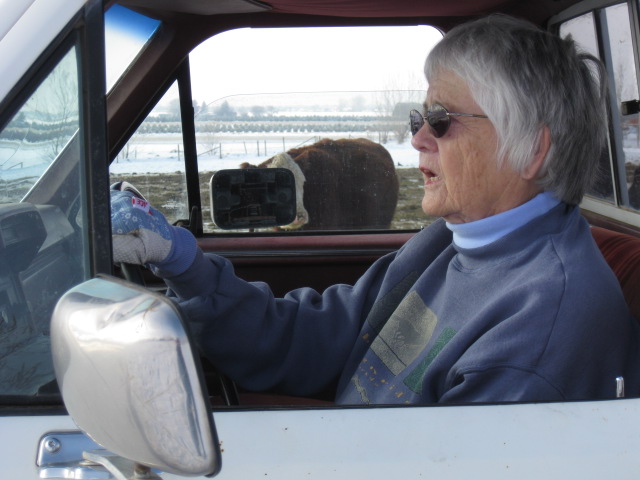
Jean, out helping feed, driving the pickup

           Is it a gender thing or not? I cannot back up a car let alone a pickup, truck, or tractor, worth a darn. I’m told to turn left, I turn right, I’m told to go straight, I go crooked, I do stop when I’m told, but that’s about it. I can’t take instructions from looking in the rearview or side mirrors. When they signal me through those means, I always turn opposite from what I’m supposed to. I can’t even follow instructions if someone is standing in front of the vehicle and trying to direct me. The gestures they use don’t mean a thing to me. And I hear about my lack of ability to back up in not too pleasant of language.
            I’ve watched my men folk back up expertly from the time I was a teenager. I remember my brother’s backing up the truck loaded with sacks of potatoes into the cellar. They communicated with whistles. Out in the field, my Dad always communicated with whistling, so they picked it up from him. I don’t know what the signals were because I can’t whistle loud, but they knew, and they could back-up into the big black hole of a cellar without hitting any of the poles or the doors. I would probably have a problem driving forward and getting in straight!
            The other day I was backing out of the garage and forgot to open the garage door. The car was just creeping and I heard the noise just as the back of the car gently scraped the garage door, so there wasn’t any damage to either door or car, but it is another example of not being able to back up.
            Last summer when I was backing the car out of the garage, I was visiting with Jon, our son, while doing so. I noticed some men working in the yard waving their arms wildly just as Jon said “You’re going to hit it!” I threw on the brakes just as I hit a car parked behind me. The car wasn’t hurt, just a scratch because I wasn’t going that fast, but the young man who owned it started parking at a different spot.
            I watch Boyd back up to a trailer and he can come close to perfect the first try. I have been on the end guiding him the direction he should go. I’m not sure I’m worth having at that end of the back-up process either, but he hasn’t complained about that. However, he will often get out of the pickup to see where he is at while I am there guiding him. Kind of lets you know that I’m somewhat lacking in ability to not only back up but to give instructions.
            Boyd can back across the yard without a mishap. I can’t. My car, for some reason, doesn’t obey my commands when backing up and will go the wrong direction. Maybe if I could get a “voice command” car where I could say: “I want to back up straight toward that gate,” the car would follow my command. And it wouldn’t say “which gate?” or “why do you want to go that way when it would be simpler to go another way?”
            I can’t park the car in a horizontal parking place either. Probably because it entails backing up again. I think I’m turning the wheels the way they should go and I end up out in the middle of the street. I’ve found it’s easier to walk five or six blocks after finding an easy parking spot than trying to park horizontally.
            At the age I am, I don’t think I will ever learn how to back up. But I’m not ashamed to admit that I can’t do it and tell the guys to do it themselves rather than to put me through the turmoil of trying something impossible.

Saturday, March 10, 2012

THE SIMPLOT GAMES

Skyler Young at a track meet in 2011

A couple of weeks ago we drove down to Pocatello to watch the Simplot Games track and field meet. What an inspiring day that was as we watched high school-age men and women compete. Those participants came from all over the United States and Canada. We witnessed sprinting, jumping, pole vaulting, and throwing the shot put. It was set up so that at least five events were going on simultaneously. If there was a lull in one event, there would be at least four other events to keep you interested. And there was the participants sitting in the bleachers that we could visit with and learn more about their experience in being involved in this event.
As one of the West’s premier high school track and field events, each year, on the third weekend in February, the Simplot Games offers high school athletes the opportunity to compete against the competitors in the U.S and Canada. Held at the Holt Arena on the campus of Idaho State University, this special 200 meter banked-board track is one of the fastest in the nation and one where records are broken each year.
In researching the Simplot Company, I found the following statements on their web site:
“We believe successful companies must be responsible members of society in other ways, too. Through such activities as our annual Simplot Games track meet, we regularly support a wide variety of needs in communities where we operate.”
“The J.R. Simplot Company, sponsor of the Games since 1979, is dedicated to providing a positive experience for all participants, and prides itself in putting on a meet that is well organized and officiated by a qualified professional staff.”
Some of the 2000 young athletes who take part in the Simplot Games each year go on to excel in college track and field. Others have been known to go on to the Olympics. But for everyone who competes, and everyone who observes, the Simplot Games provides special and rewarding experiences.
One of the new activities at the games this year was called “The Fast and the Farmers.” Sponsored by the J. R. Simplot Company, in a green booth next to the track and using special technology, athletes were able to have their pictures taken in different farm settings. While at the booth, Future Farmers of America members quizzed athletes on their farm knowledge. This booth was put together with the idea of participating athletes leaving with a better understanding of agriculture plus the awareness of Simplot’s role in the global food system.
What a way to spread the word on agriculture, to help dispel rumors and wrong ideas about how we in agriculture operate. Simplot must be applauded for their efforts in not only sponsoring this track and field event, but also for using the event to educate participants about agriculture.
Yes, this was a day well spent. Even for us old duffers, this was a fun day mingling with young athletes and feeling the excitement in the air with all of the events. You know, we all complain about today’s teenagers and the way they live their lives, the way they dress, and the way they speak. But on a day like this spent watching them compete, working hard at what they do, you see exemplary young men and women. You see youth willing to sacrifice to be able to meet goals. You see coaches who inspire hard work and a desire to better themselves in the youth they work with. You see families willing to spend time and money to travel across the United States so their children can compete. There is a lot to observe on and off the track at an event like this.
This was the fourth year we have gone to Pocatello to watch the Simplot Games, and I’m already looking forward to the one next year.


Sunday, March 4, 2012

MARKETING

                                                                             JAEDN YOUNG


            Marketing is an important part of agriculture. When my dad and father-in-law were active in farming/ranching, marketing was mostly regional. I remember Dad being on the phone with sheep people, buying and selling his sheep. Boyd’s dad worked with regional grain elevators to get rid of his harvested crop. But we now live with global markets. There are a lot of seminars available to help farmer/ranchers learn about marketing. We have often attended workshops on this subject when we’ve gone to wheat producer conferences. We always came home with good intentions. But it is hard to change old habits.
            I guess I hadn’t thought too much about our marketing strategies until recently. Our grandson, Jaedn, is in the FFA program over in Baker City, Oregon. Jaedn and his brother, Skyler, have moved pipe here on the valley farm, fixed fence at the ranch, and done general farm work where and when needed for quite a few years.
            Well, they were studying marketing in FFA, so Jaedn had to answer some questions on a test about marketing cows. His answer to a question on the marketing plan for cattle was: “Sell when you need the money or sell a cow if her calf dies.” That wasn’t the correct answer. When asked who owned the cows on the ranch he worked on, he told them Grandma and Grandpa. “What cows belong to Grandma?” another question. He answered, “The dead ones.” He had heard us talking one day and I mentioned that whenever a cow died Boyd looked at me and said, “That was one of yours,” so I guess his answer was correct; the dead ones are mine.
            Janna, his mom said that Jaedn was in danger of failing FFA because of the things we have been teaching him. So I had to talk to Jaedn more about our marketing procedures.
            Boyd spends a lot of time at the Wednesday livestock sale in Idaho Falls, and often travels to Blackfoot on Fridays for the sale there. He watches, listens and makes decisions. He is good at watching the ups and downs in the sales of the cattle and determines through this on-site research when he is going to sell his calves. Then he gets on the phone calling potential buyers. This past year he, our son Derrald, and nephew Jay, worked with a company to sell the calves via an on-line auction. That was interesting and educational. The day of the auction, my laptop computer was put on the kitchen counter, chairs placed around it, and we had about 8 people watching the sale.
            Boyd always weeds out some cows each year. He takes into consideration their age, their ability to raise a good calf, and their health. This also is considered part of his marketing plan.
            Now, selling wheat seems to be a bit different. I’ve often accused Boyd of waiting until the price of wheat hits bottom, and then he sells. When the price is up, he says he thinks he had better watch it awhile. This might be when it is true that he “sells when he needs the money.” Although Boyd does read market reports, gets weekly news briefs on-line with the price paid for all grains, and visits with local elevator owners.
            But to put a marketing plan on paper just doesn’t seem to work for us. Those long-range plans don’t seem to take into consideration weather changes, drought, hail, early snow, no snow, or when we might need money. So Boyd’s wheat marketing plan is in his head.
            Jaedn needs to realize that his grandfather does know how to market his cows and wheat. And maybe when he comes back to be with us this year, we can talk a little more about this with him. Jaedn and Skyler each have a cow now, so he needs to learn more, not only about the care and treatment of the animal, but the potential of marketing. And we don’t want Jaedn to fail FFA!

Monday, February 27, 2012

DUMB LAWS

Sydney Schwieder riding a horse without a helmet!
According to Bryce Glenn’s February 8th Post Register column “Looking Back,” a bill was presented in the 1937 Idaho Legislature to ban the use of radios in automobiles. This got me thinking of some of the bills that are presented and passed with our present Legislature, and maybe some things that should have been made into laws.
I am aware that hooking up seat belts and wearing helmets when riding a motorcycle are safety measures, but I’m not sure we need laws for things like that. The person injured is the person refusing to do these things, thus they are the ones to take the consequences of not following safety precautions. Why do our lawmakers need to spend time making laws to protect us from ourselves?
            What about all the times I washed with the wringer washing machine? I always had the kids helping me and they liked to put the clothes through the wringer. I would put a chair for them to stand on and one would put the clothes into the wringer and another one would be on the other side taking the clothes out. Many times my girls, with long hair, got their hair caught in the wringer. I never left them alone to do this, so we were able to reverse the direction of the wringer and get the hair untangled quickly. Maybe the legislature at that time should have made a law requiring anyone using a wringer washing machine to wear a helmet.
            We never wore helmets to ride horses or bikes when I was young. And we often fell and got scraped and skinned up, even broke a few bones. Once when heading for the swimming hole on Sand Creek, I rode behind my sister on her bike. We weren’t wearing shoes as we were dressed to jump right into the creek. However, I got my foot caught in the spokes of the back tire of the bike. I certainly felt that painful consequence of not wearing shoes when on a bike, and I didn’t need a law telling me to wear shoes next time.
            One time, before the advent of seat belts, I was driving to the ranch with the kids. Our youngest was sitting next to me in one of those car seats that hooked over the back of the seat, and put him so he could see out the window. I had bought groceries and the kids got some candy. Well on the way, the little one swallowed a piece of candy and started choking. Pulling the car over to the side of the road, I grabbed him out of the car seat, put him upside down out the window, held onto one leg and gave him a couple of good swats on his upper back. The candy, plus breakfast, came right up. Pulling him back into the car, I put him back in the car seat and we went on our way. One of these newer car seats wouldn’t have prevented the choking. Do you think a law making it illegal go give children candy before riding in the car would have helped?.
            The other day we watched a DVD of a parade of old tractors, combines, threshing machines, and other farm equipment. The thing that really got my attention was the lack of safety shields over moving parts of these machines, and only an iron seat to sit on – no fancy upholstery, no padding, no springs to make the seat flexible, just cold iron. Those first machines were rough looking, just the basics to get them going. But they sure made a difference to the farming communities. And things have been made safer as new machines are developed. I’m not sure if laws were passed to put those safety shields on the equipment or not, but could have been.
            I guess my question is: do our law makers need to spend their time creating laws to protect us from the stupid things we do?